HOPE IN A COLD CLIMATE
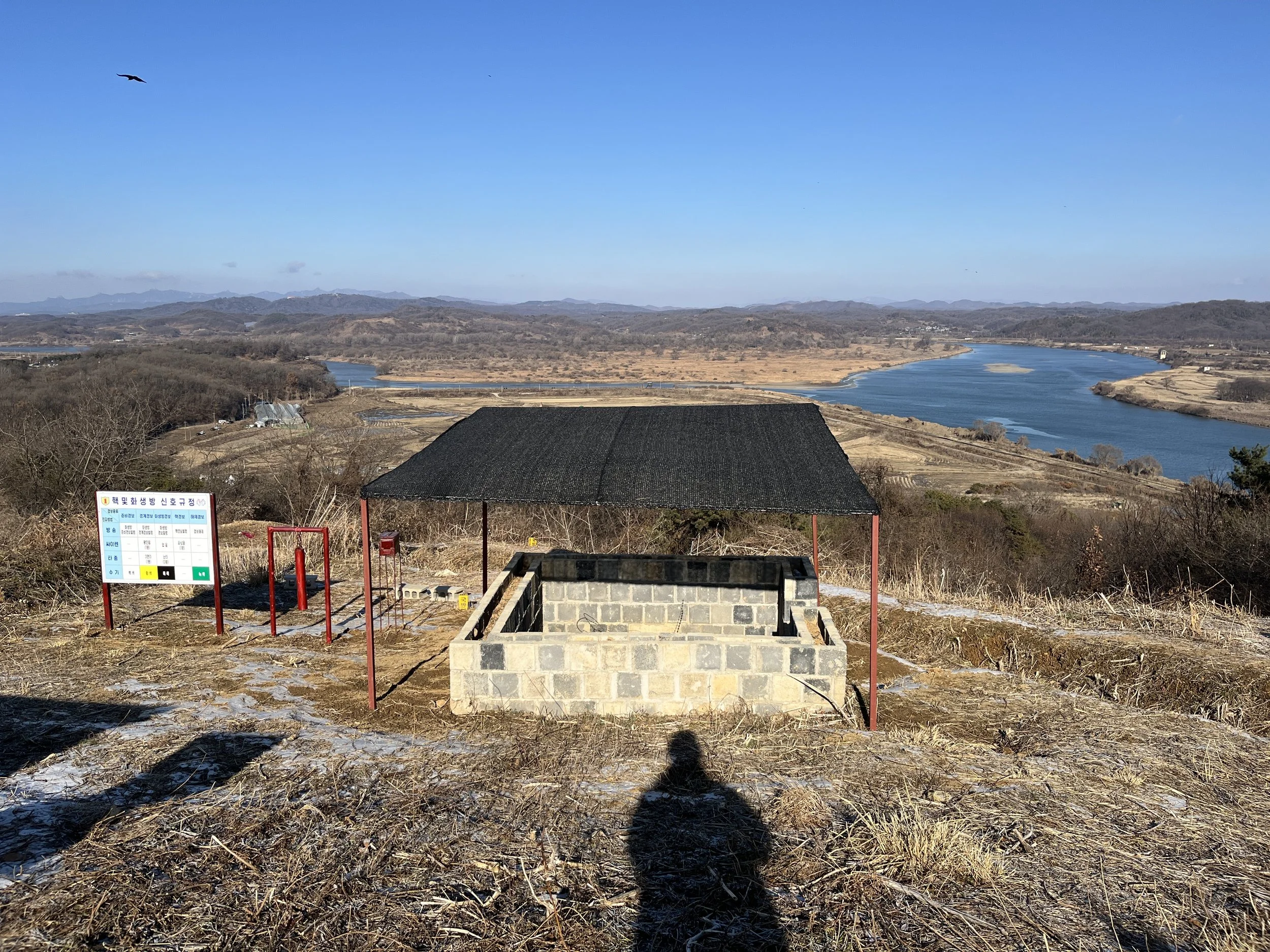
Here’s the view from near my house, looking towards North Korea, photographed on New Year’s Day. Today, January 3rd, at 10.00am,, it’s currently -6 degrees. Chilly!
I’m currently working on a book for Thames & Hudson called How Art Can Give You Hope. It’s picture-led and intended for a wide readership. More on this project later, but now, as we begin 2026, I want to share some thoughts on hope, and will focus on some positive - hopeful - signs.
The special varieties of hope we now need to nurture are those that focus our attention not just on providing a new and more prosperous future but that also rescue what is still valuable from the old world - from the past. This implies forms of hope that rather than being uniquely directed towards opening up new uncharted spaces through science and technology also focus our attention on ensuring that good things are passed down to posterity, to future generations.
But due to human activities, the stable climatic and biosphere conditions that have served as the unmovable and seemingly eternal foundations upon which human hopes have been founded can no longer be taken for granted. Scientists say that we have exited the Holocene geological epoch, beginning around 11,700 years ago, and entered the Anthropocene, an epoch in which humanity’s impact on the environment is determining not just its own fate but also that of every living thing on Planet Earth.
The Holocene provided several vital key constants: meteorological limits, seasonality, ecological renewal, the possibility of permanent abiding and hence the establishment of settlements, faith in providence and therefore the creation of religious cosmology, and, more recently, faith in the potential of reason and scientific research to understand and the control of natural resources to furnish a better future. But in the Holocene what has been taken for granted as the permanent backdrop to human affairs is now in the foreground, the primary agent, the primary protagonist. This means the environmental constants shared by pre-agrarian, agrarian, and industrial societies and are not any longer the unmoving foundations upon which a viable assessment of future possibilities can be founded. The old yardsticks of meaning and value that produced civilizations in the past are now actually proving environmentally malign, threatening not just human but also planetary extinction. so, we need varieties of hope that locate us within a continuum that constructs a prosperous future on the bedrock of our past, and thereby helps us re-connect lovingly with the world.
*
In many ways, we are actually better prepared than ever to respond to the existential threats this unprecedented situation present. In the global north people live in information rich societies in which they have at their disposal unprecedented amounts of data. Until very recently, all human societies were information poor, and so their hopes were narrowly conceived, nurtured, and pursued within the context of such paucity. The kinds of things in which people placed their hope were firmly rooted in local conditions and thought to be immutable and binding. Now, within a world linked via complex networks, people increasingly recognize that their hopes are fundamentally like those of other humans, but are also determined by specific social and historical conditions. Our unprecedented awareness of the vast field of hopeful goals, both past and present, can make us better prepared for the obstacles we face. Meanwhile, the advent of AI, which provides detailed examination of impersonal datasets, marshaling facts and rapidly processes them, can help us find solutions to seemingly intractable problems. AI algorithms deliver unprecedentedly accurate assessments of future probabilities, thereby significantly changing how we relate to the uncertain openness of the future. AI can aid us in making rational choices about where to place our hope.
Developing in the present a positive relationship to the future will depend on our moral sensitivity, and despite all the obvious signs of brutal inhumanity focused on by the mass media, which leads to our endless ‘doom scrolling’, in the West there has in been very real progress towards a general heightening of moral sensibility. This has occurred both inwardly and outwardly. More people are aware of their own ‘interiority’, of their own self-reflexive identity and responsibility as moral agents. The open societies in which they live display higher levels of civility, and people recognize the need to alleviate poverty, and they wish for the flourishing of others. For the first time in history there is widespread recognition that cruelty is unacceptable, and in the name of justice people increasingly oppose oppression, discrimination, and violence. Significantly, the heightening of people’s moral sensibility, at least in the wealthy global north, has led to the expanding of concern for the non-human world after a period characterized primarily by an anthropocentrism that has treated the non-human as an exploitable resource. More people today show concern for animal welfare and recognize the vital importance of developing a sustainable relationship with the environment.
OK. These are some positive possibilities. In my next blog, I consider the ‘negative’ side of our present condition, and how it’s making it increasingly difficult to know in what to place our hope today.