HOPE IN A COLD CLIMATE
I’m currently working on a book for Thames & Hudson called How Art Can Give You Hope. It’s picture-led and intended for a wide readership. More on this project later, but now, as we begin 2026, I want to share some thoughts on hope, focusing on some positive - hopeful - signs.
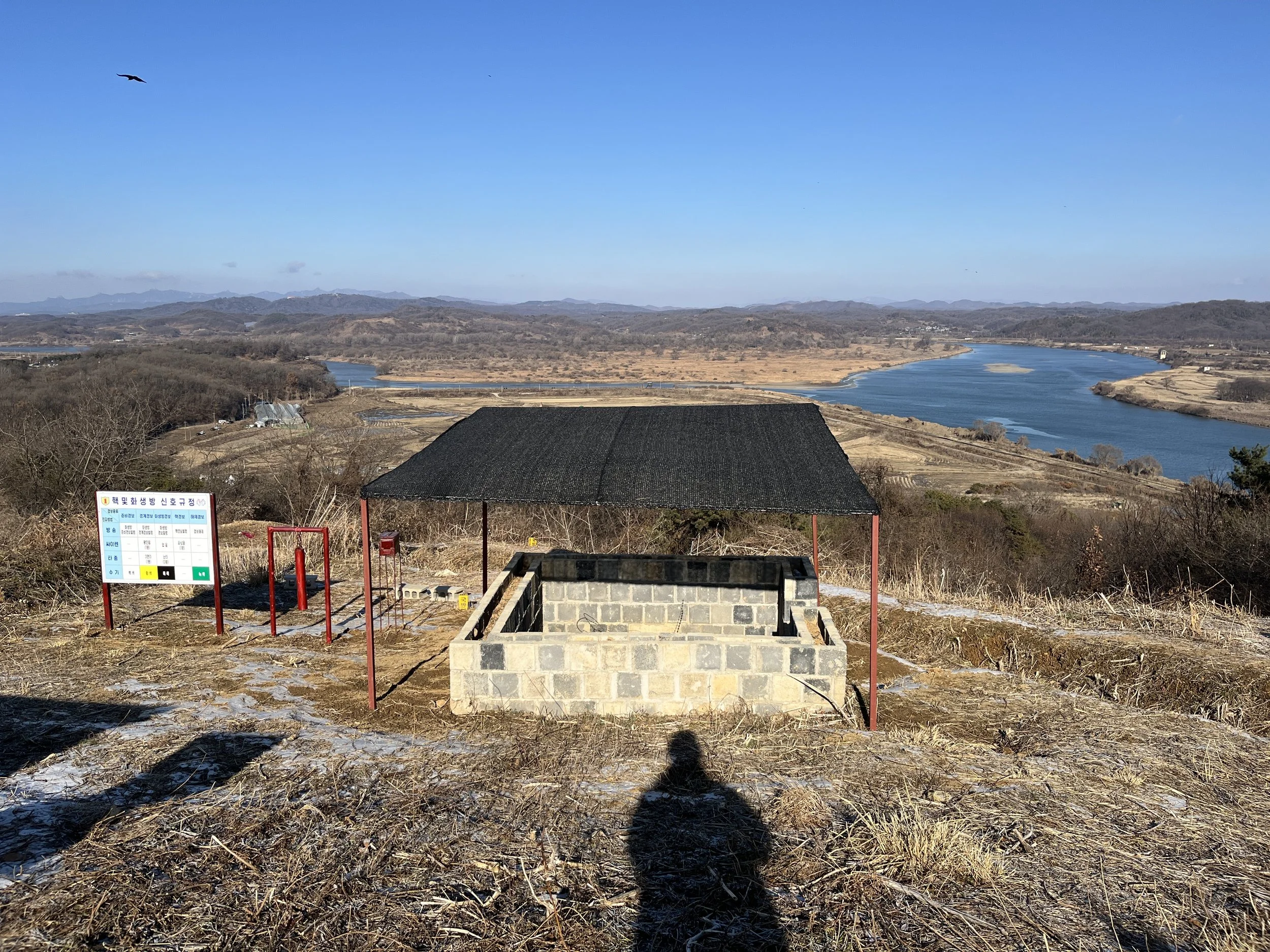
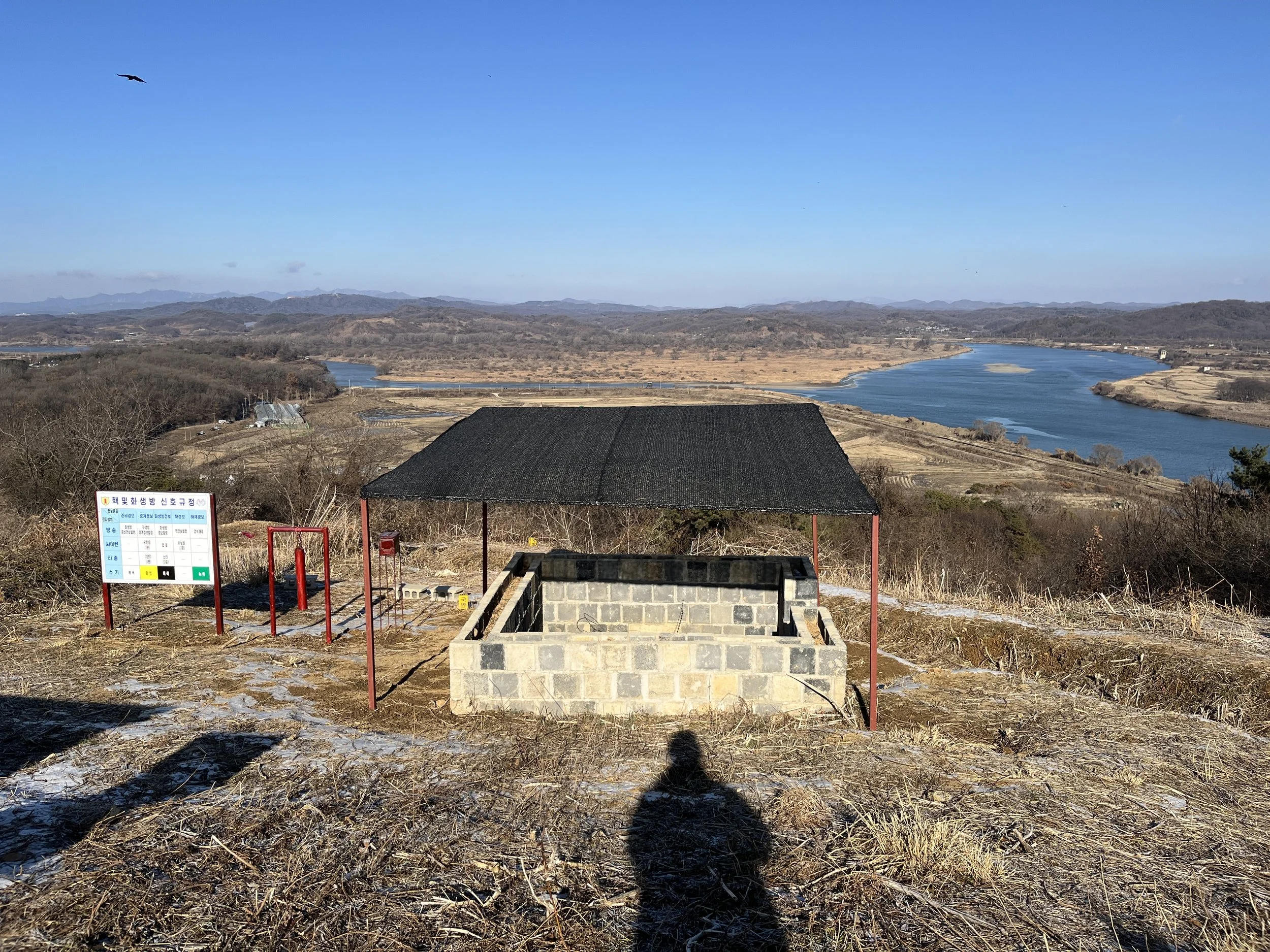
Here’s the view from near my house, looking towards North Korea, photographed on New Year’s Day. Today, January 3rd, at 10.00am,, it’s currently -6 degrees. Chilly!
I’m currently working on a book for Thames & Hudson called How Art Can Give You Hope. It’s picture-led and intended for a wide readership. More on this project later, but now, as we begin 2026, I want to share some thoughts on hope, and will focus on some positive - hopeful - signs.
The special varieties of hope we now need to nurture are those that focus our attention not just on providing a new and more prosperous future but that also rescue what is still valuable from the old world - from the past. This implies forms of hope that rather than being uniquely directed towards opening up new uncharted spaces through science and technology also focus our attention on ensuring that good things are passed down to posterity, to future generations.
But due to human activities, the stable climatic and biosphere conditions that have served as the unmovable and seemingly eternal foundations upon which human hopes have been founded can no longer be taken for granted. Scientists say that we have exited the Holocene geological epoch, beginning around 11,700 years ago, and entered the Anthropocene, an epoch in which humanity’s impact on the environment is determining not just its own fate but also that of every living thing on Planet Earth.
The Holocene provided several vital key constants: meteorological limits, seasonality, ecological renewal, the possibility of permanent abiding and hence the establishment of settlements, faith in providence and therefore the creation of religious cosmology, and, more recently, faith in the potential of reason and scientific research to understand and the control of natural resources to furnish a better future. But in the Holocene what has been taken for granted as the permanent backdrop to human affairs is now in the foreground, the primary agent, the primary protagonist. This means the environmental constants shared by pre-agrarian, agrarian, and industrial societies and are not any longer the unmoving foundations upon which a viable assessment of future possibilities can be founded. The old yardsticks of meaning and value that produced civilizations in the past are now actually proving environmentally malign, threatening not just human but also planetary extinction. so, we need varieties of hope that locate us within a continuum that constructs a prosperous future on the bedrock of our past, and thereby helps us re-connect lovingly with the world.
*
In many ways, we are actually better prepared than ever to respond to the existential threats this unprecedented situation present. In the global north people live in information rich societies in which they have at their disposal unprecedented amounts of data. Until very recently, all human societies were information poor, and so their hopes were narrowly conceived, nurtured, and pursued within the context of such paucity. The kinds of things in which people placed their hope were firmly rooted in local conditions and thought to be immutable and binding. Now, within a world linked via complex networks, people increasingly recognize that their hopes are fundamentally like those of other humans, but are also determined by specific social and historical conditions. Our unprecedented awareness of the vast field of hopeful goals, both past and present, can make us better prepared for the obstacles we face. Meanwhile, the advent of AI, which provides detailed examination of impersonal datasets, marshaling facts and rapidly processes them, can help us find solutions to seemingly intractable problems. AI algorithms deliver unprecedentedly accurate assessments of future probabilities, thereby significantly changing how we relate to the uncertain openness of the future. AI can aid us in making rational choices about where to place our hope.
Developing in the present a positive relationship to the future will depend on our moral sensitivity, and despite all the obvious signs of brutal inhumanity focused on by the mass media, which leads to our endless ‘doom scrolling’, in the West there has in been very real progress towards a general heightening of moral sensibility. This has occurred both inwardly and outwardly. More people are aware of their own ‘interiority’, of their own self-reflexive identity and responsibility as moral agents. The open societies in which they live display higher levels of civility, and people recognize the need to alleviate poverty, and they wish for the flourishing of others. For the first time in history there is widespread recognition that cruelty is unacceptable, and in the name of justice people increasingly oppose oppression, discrimination, and violence. Significantly, the heightening of people’s moral sensibility, at least in the wealthy global north, has led to the expanding of concern for the non-human world after a period characterized primarily by an anthropocentrism that has treated the non-human as an exploitable resource. More people today show concern for animal welfare and recognize the vital importance of developing a sustainable relationship with the environment.
OK. These are some positive possibilities. In my next blog, I consider the ‘negative’ side of our present condition, and how it’s making it increasingly difficult to know in what to place our hope today.

‘SPECISME SEXISME RACISME LES VRAIS INVISIBLES!
While I was walking around the city of Bourges in central France, which is forty minutes north of the village where I have my house, and from where I’m writing this post, I noticed this prominently sited mural that declares: ‘SPECISME SEXISME RACISME LES VRAIS INVISIBLES! (Species-ism, Sexism, Racism The True Invisibles!) What especially struck me was the presence of the first term, which I hadn’t really considered so obviously a characteristic dimension of the by now other two familiar ‘systemic’ prejudices blighting society. But because of humanly driven climate change we are certainly going to hear much, much more about systemic ‘species-ism’.

While I was walking around the city of Bourges, which is forty minutes north of the village where I have my house in central France, and from where I’m writing this post, I noticed this prominently sited mural. It says on the left: ‘SPECISME SEXISME RACISME LES VRAIS INVISIBLES! (Species-ism, Sexism, Racism The True Invisibles!)
What especially struck me was the presence of the first term, which I hadn’t really considered so obviously a characteristic dimension of the ‘systemic’ prejudices blighting society. But because of humanly-driven climate change we are certainly going to hear much, much more about how our inter-species violence also extends to the trans-species - and beyond. When you line up ‘species-ism’ alongside ‘sexism’ and ‘racism’ you’re enlarging the case against humans to take into account violence not just against other humans but against other animals.
An online dictionary defines ‘species-ism’ or ‘speciesism’ as: “the assumption of human superiority leading to the exploitation of animals.” In this sense, it’s used by radical vegetarians who declare, for example, that ‘meat is murder’. But why stop at what we’ve done to fauna? Why not extend the condemnation to flora as well? Even to rocks and minerals and things like rivers and seas? After all, wide-scale environmental abuse is why we are now calling the epoch the Anthropocene. In the current cultural context, ‘species-ism’ is actually a sub-set of the wider malign legacy of civilization: anthropocentrism. We humans adopt an exploitative position in relation to the world by putting the interest of our own species first - at the centre. For millennia we have certainly been lording it over non-humans – other animals - but also the entire biosphere. The result is that we have brought the Earth to a potentially catastrophic precipice.
*
Humankind certainly seems to have a general tendency towards anthropomorphic projection. As the French anthropologist Philippe Descola observes, humans have “a propensity to interpret phenomena and behaviour observable in their natural environment by endowing non-humans with qualities that are similar to those of humans.” Indigenous peoples practice anthropomorphic projection, but as anthropologists have shown, they are not aggressively anthropocentric. For them, seeing the world anthropomorphically also means having specific obligations in relation to non-humans, the possibility of opening social relations with them. Descola describes what he terms “identification”:
It results from the fact that humans arrive in the world equipped with a certain kind of body and with a theory of mind, i.e. endowed with a specific biological complex of forms, functions, and substances, on the one hand, and with a capacity to attribute to others mental states identical to their own, on the other hand. This equipment allows us to proceed to identifications in the sense that it provides the elementary mechanism for recognising differences and similarities between self and other worldly objects, by inferring analogies and distinctions of appearances, behaviour and qualities between what I surmise I am and what I surmise the others are. In other words, the ontological status of the objects in my environment depends upon my capacity to posit or not, with regard to an indeterminate alter, an interiority and a physicality analogous to the ones I believe I am endowed with. I take interiority here in a deliberately vague sense that, according to the context, will refer to the attributes ordinarily associated with the soul, the mind, or consciousness – intentionality, subjectivity, reflexivity, the aptitude to dream – or to more abstract characteristics such as the idea that I share with an alter a same essence or origin. Physicality, by contrast, refers to form, substance, physiological, perceptual, sensory-motor, and proprioceptive processes, or even temperament as an expression of the influence of bodily humours.


Anthropocentrism is something else altogether. In effect, it drives a wedge between humans and everything else. This is how the Australian environmental philosopher Freya Mathews ( a recent discovery for me) describes it in The Dao of Civilization (2023) “ Anthropocentrism was the groundless belief, amounting to nothing more than a prejudice, that only human beings matter, morally speaking; to the extent that anything else – animals, plants, ecosystems, the natural world generally – matters, it does so only because it has some kind of utility for human beings.” Mathews traces anthropocentrism to as long ago as the Neolithic agrarian revolution, so as to understand how the animist focus of anthropomorphism, which is still evident in Indigenous cultures today, became perverted into anthropocentrism. As she writes in her most famous book, The Ecological Self (1991) once anthropocentrism was wedded to the mechanistic scientific worldview in the seventeenth century Europe, the recipe for ecological disaster was prepared: ‘from a mechanistic perspective, Nature is itself devoid of interests and is therefore indifferent, so to speak, to its own fate. Nothing that happens to it matters to it. It is in this sense, in itself, devoid of value.” A dualistic relationship was established between ‘nature’ (the non-human) and ‘culture’ (the human) within which ‘civilization’ became inherently exploitative and violent.
Clearly, an anthropocentric worldview is not so much the opposite of anthropomorphism as described by Descola in relation to the Indigenous worldview but rather a possible deviant consequence of anthropomorphism, one where the human capacity to project onto and identify with the world carries with it feelings of separation, superiority, and aggressive entitlement. The key point is that anthropomorphism in itself is surely a ‘good thing’ and certainly does not preclude the recognition that humans and non-humans are separated by differences of degree, not of kind. But how can we restore to anthropocentrism a less arrogantly controlling and more generously reciprocal attitude to the world within which we live?
Mathews and other environmentalists and ecologists urge us to shake of this malign anthropocentric relationship to the world and become instead ‘biocentric’ or ‘ecocentric’. The former stance implies we recognize living things carry equal and inherent value, while the latter extends this recognition to indicate that environmental systems as wholes carry inherent value. Both ‘-isms’ clearly seek to displace humans from the centre, where the centre is deemed to confer unique and superior status.
but I’m not sure making reference to the trio of species-ism, sexism, and racism is the right way forward. After all, wedding speciesi-sm with the other two potentially feeds the very anthropocentrism we’re supposed to be overcoming. In fact, one could argue that the more we ring our hands over the human cost to the environment, the more we draw attention to ourselves. So, in this sense, all we are indulging is a negative anthropocentrism. Maybe even nihilistic anthropocentrism. Also, when you think about it, calling a whole geological time period the ‘Anthropocene’ can seem like an extreme case of anthropocentrism: “Wow! We made it! We’ve finally put ourselves at the real centre. Well, at least, the centre of planet Earth.” Thankfully, there’s still a whole galaxy out there which knows absolutely nothing about a messed-up species of bipedal animals descended from apes.
REFERENCES
The Philippe Descola quote is from his essay ‘Human Natures’ in Quaderns (2011) 27, available on-line at: https://www.raco.cat/index.php/QuadernsICA/article/download/258367/351466
The Freya Mathews quote is from The Dao of Civilization. A Letter to China, published by Anthem Press, 2023. https://anthempress.com/on-the-dao-of-civilization-a-philosopher-s-letter-to-the-supreme-leader-pb
The Ecological Self is published by Routledge. https://www.routledge.com/The-Ecological-Self/Mathews/p/book/9780367705183