STOP THE STEAL, Korean Style!

Supporters of Yoon Suk Yeol waving South Korean and American flags at a rally near the presidential residence in Seoul in March, 2025. JUNG YEON-JE / AFP - Getty Image
One of the weirdest sights in Seoul over the past year has been supporters of the disgraced and impeached former President, Yoon Suk Yeol, marching through the centre and holding banners saying (in English) ‘STOP THE STEAL’.
On many levels South Korea is modeled on America, and now, a significant proportion of its people are adopting contemporary America’s crazy disavowal of fact-based reality. Like lemmings, Yoon’s followers are following Trump and his cronies and the hordes of MAGA supporters over an epistemological precipice.
With this kind of craziness in mind, I decided to make a couple of works in my Book-Painting series based on the first edition covers of two of Hannah Arendt’s classic works: The Origins of Totalitarianism (1951) and The Human Condition (1958). Here they are:
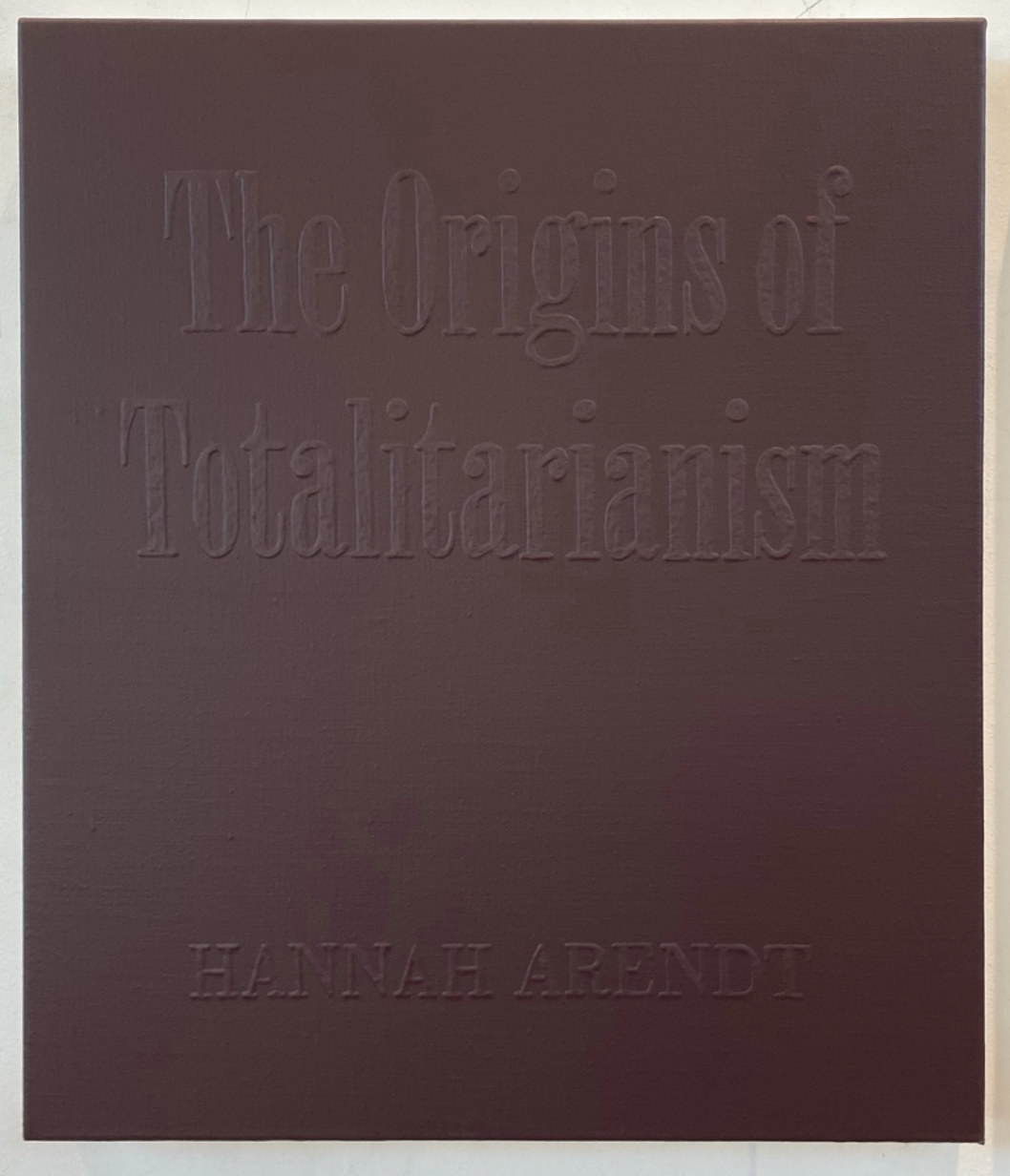
‘Hannah Arendt, The Origins of Totalitarianism (1951’), 2025, acrylic on canvas, 53 x 45.4 x 4cm.
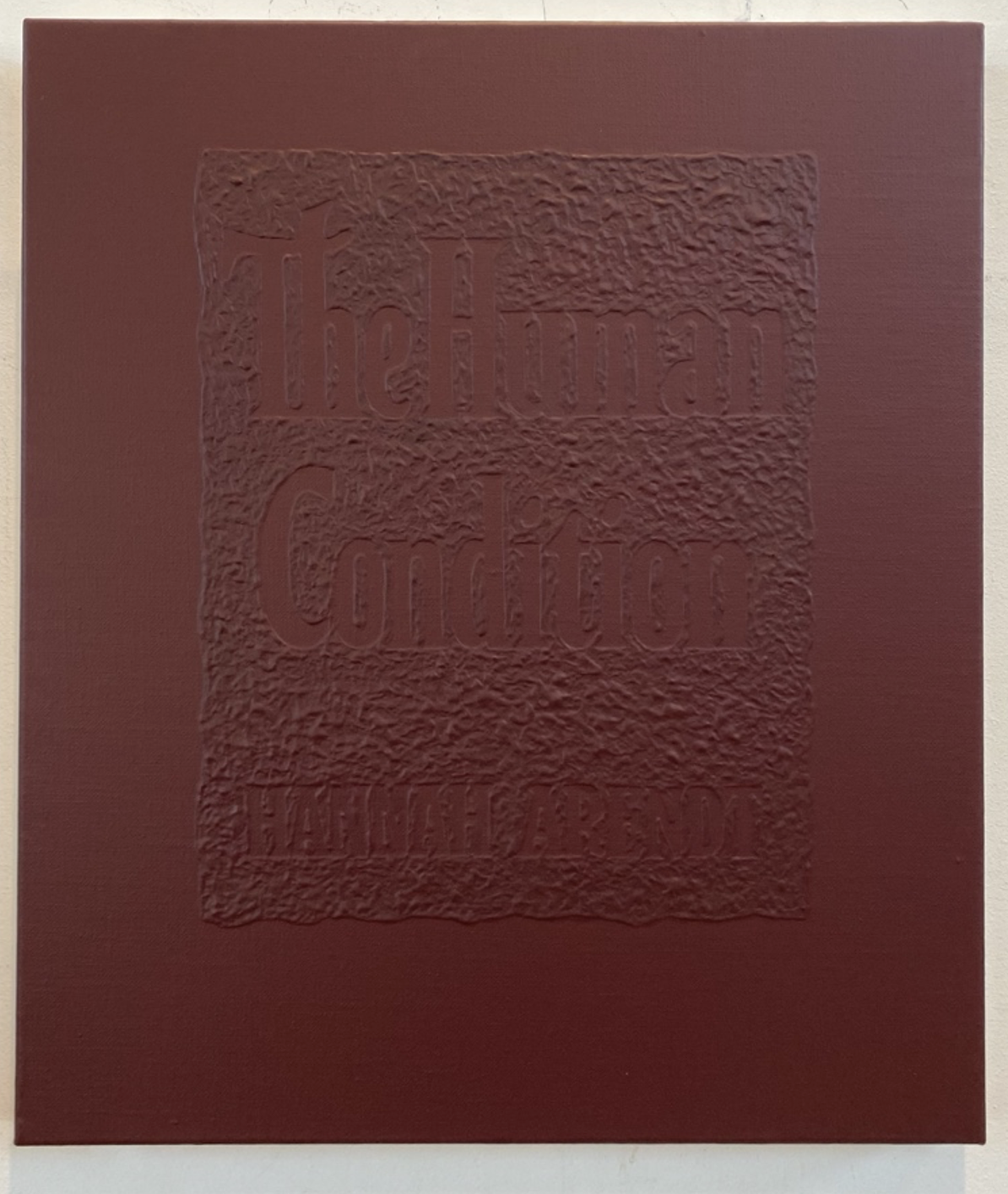
Hannah Arendt, The Human Condition (1958), 2025, acrylic on canvas, 53 x 45.4 x 4cm
I chose to paint them in colors inspired by the originals - a sort of dried blood color. Here are these original covers:
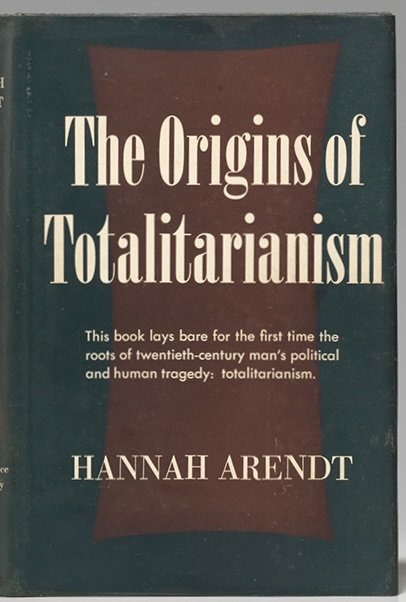
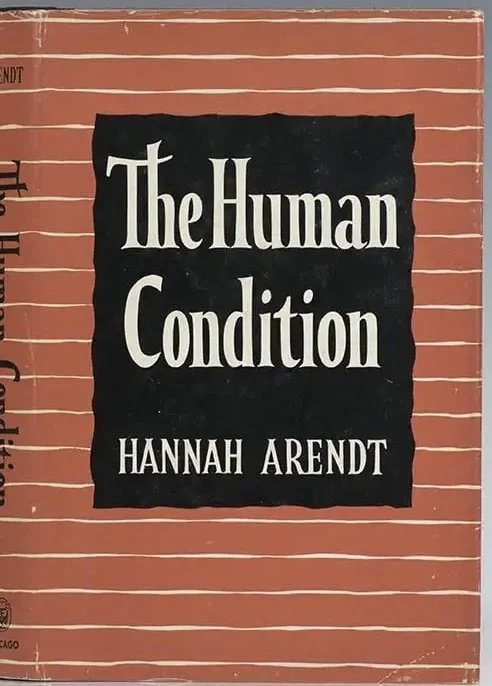
In the light of the Korean STOP THE STEAL travesty, I thought it would be a good idea to share some quotations from these books. Although published in the 1950s, they still shed a scarily prescient light on the present. The Origins of Totalitarianism was written with the horrors of Nazism fresh in people’s minds and when Stalinism was a continuing nightmare, which was also the time of the Korean War, a conflict caused by the establishment of a new totalitarian regime in North Korea backed by Stalin, and one that has proven horribly enduring. The quotations I’ve chosen from the book The Origins focus on the role of mass propaganda in relation to politics. Arendt argues that “the masses are obsessed by a desire to escape from reality because in their essential homelessness they can no longer bear its accidental, incomprehensible aspects” (page 352). She uses this term “masses” throughout the book, which sound condescending nowadays. It goes without saying that Arendt and her peers (and you, dear reader) are not members of this ignorant social category. But perhaps she underestimated the extent to which everyone feels, as she puts it, “homeless” in modern society.
Here are some more quotations:
“The masses escape from reality is a verdict against the world in which they are forced to live and in which they cannot exist, since coincidence has become its supreme master and human beings need the constant transformation of chaotic and accidental conditions into a man-made pattern of relative consistency.” (page 353)
“[T]hey [the masses] do not believe in anything visible, in the reality of their own experience; they do not trust their eyes and ears but only their imagination, which may be caught by anything that is at once universal and consistent in itself. What convinces masses are not facts, and not even invented facts, but only the consistency of the system of which they are presumably part.” (Page 251)
”A mixture of gullibility and cynicism has been an outstanding characteristic of mob mentality before it became an everyday phenomenon of masses. In an ever-changing, incomprehensible world the masses had reached the point where they would, at the same time, believe everything and nothing, think that everything was possible and that nothing is true. The mixture in itself was remarkable enough, because it spelled the end of the illusion that gullibility was a weakness of unsuspecting primitive souls and cynicism the vice of the superior and refined minds. Mass propaganda discovered that its audience was ready at all times to believe the worst, no matter how absurd, and did not particularly object to being deceived because it held every statement to a be a lie anyhow......[U]under such conditions, one could make people believe the most fantastic statements one day, and trust that if the next day they were given irrefutable proof of their falsehood, they would take refuge in cynicism; instead of deserting the leaders who lied to them, they would protest that they had known all along that the statement was a lie and would admire the leaders for their superior tactical cleverness.” (page 383).
This last quotation could be used word-for-word to describe the roots and methods of Trumpism. Such ‘populism’ certainly thrives in a climate of gullibility and cynicism. But there are obviously significant differences between what Arendt calls ‘totalitarianism’ and ‘populism’, above all because the latter is a response to a level of globalization that in the period Arendt was writing was absent. ‘Populism’ is also primarily a Western phenomenon, a backlash to the excesses and failures of neoliberalism. It is also effecting countries like South Korea that have brought so wholeheartedly into the myth of neoliberalism. But there is also an underlying continuity between ‘totalitarianism and ‘populism’: the feeling of powerlessness. Michael Cox, the Founding Director of LSE IDEAS, in an essay entitled ‘Understanding the Global Rise of Populism’ writes:
“populism is very much an expression in the West of a sense of powerlessness: the powerlessness of ordinary citizens when faced with massive changes going on all around them; but the powerlessness too of western leaders and politicians who really do not seem to have an answer to the many challenges facing the West right now. Many ordinary people might feel they have no control and express this by supporting populist movements and parties who promise to restore control to them.”
Arendt describes this pervasive sense of powerlessness as the consequence of a society in which people “are forced to live and in which they cannot exist, since coincidence has become its supreme master”, a society that deprives people of their fundamental need to constantly transform “chaotic and accidental conditions into a man-made pattern of relative consistency”. This deprivation is certainly one way of describing the appeal of conspiracy theories, which offers “the consistency of the system” and is, more generally, a symptom of the profound crisis meaningfulness precipitated by global neoliberalism .
To end, here is a quotation from Arendt’s The Human Condition which alludes to the source of the loss of a “pattern of relative consistency”. It also speaks directly to our present climate change crisis and to the fetishizing of science and technology as a solution. Arendt draws attention to how this delusion is informed by a “fateful repudiation of an Earth who was the Mother of all living creatures under the sky”, in other words, it is motivated by the deep craving to produce “ a man-made pattern of relative consistency” based on escape from the tyranny of nature:
“The earth is the very quintessence of the human condition, and earthly nature, for all we know, may be unique in the universe in providing human beings with a habitat in which that can move and breathe without effort and without artifice. The human artifice of the world separates human existence from all mere animal environment, but life itself is outside this artificial world, and through life man remains related to all other living organisms. For some time now, a great many scientific endeavors have been directed toward making life ‘artificial’, toward cutting the last tie through which even man belongs among the children of nature..... This future man, whom scientists tell us will produce in no more than a hundred years, seems to be possessed by a rebellion against human existence as it has been given”. (page 2)
REFERENCES
Hannah Arendt, The Origins of Totalitarianism, 1951 (Revised Edition, HBJ Books, 1973).
Hannah Arendt, The Human Condition (Second Edition, The University of Chicago Press, 1958).
Michael Cox, ‘Understanding the Global Rise of Populism’, (2018), https://www.lse.ac.uk/ideas/Assets/Documents/updates/LSE-IDEAS-Understanding-Global-Rise-of-Populism.pdf
Who can deny that America first conquered the world not with its armies of undercover agents but through the promiscuous circuit of its motion pictures? .... America is more than a particular culture, nation, or world power; it is a great theater of geometric projection in which the whole world now appears it itself in reduced form. Once a culture enters this space of projection there is no way back from the square to the cube. Eventually that culture becomes incomprehensible to itself. Or better, it becomes comprehensible to itself only from an ‘Americanized’ perspective, the fantasy of America standing in for the lost dimension. This is precisely why, in a world that increasingly understands itself through the medium of the screen, America’s postwar popular culture eventually appears as the only one that makes any sense. (page .146-7).