ENEMIES OF HOPE
I mentioned in my previous post (‘Hope in a Cold Climate’,January 3rd) that I’m working on a book about art and hope. In the previous post I looked on the bright side. In this one, I focus on the many ways in which things are not looking so good as far as being hopeful goes.
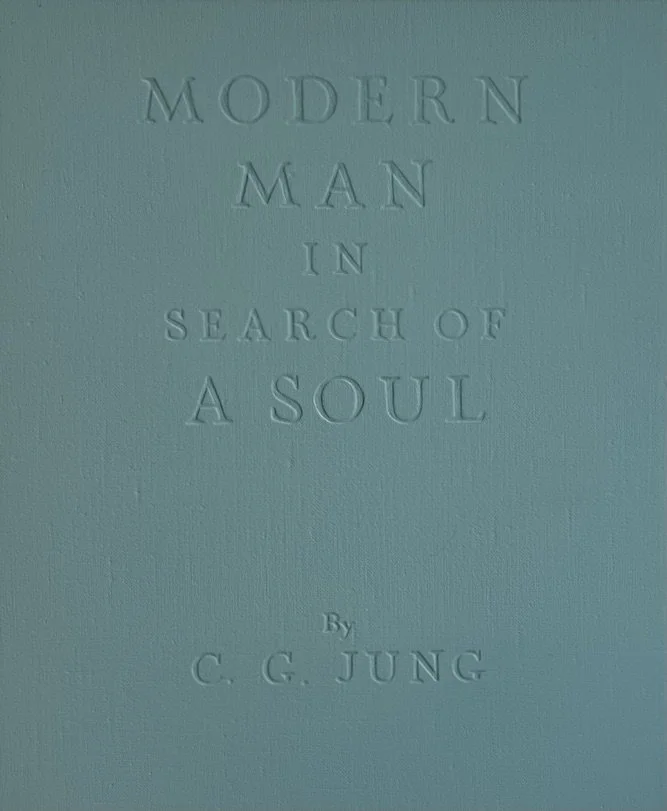
Simon Morley, Carl Jung, ‘Modern Man in Search of a Soul (1933)’, 2023, acrylic on canvas, 46x38cm. Private Collection. This is one of my ‘Book-Paintings’ - monochrome copies of book covers.
I mentioned in my previous post (‘Hope in a Cold Climate’,January 3rd) that I’m working on a book about art and hope. In the that post I looked on the bright side. In this one, I focus on the many ways in which things are not looking good as far as being hopeful goes.
Today, people often display much greater egotism than before. They dwell on their own subjective states rather than the realities of the external world and the needs of their community, and perceive the society in which they live as a fundamental obstacle in the way of their own personal development. This makes hope an increasingly private and atomized concern.
This privatization of hope is unfolding within an information rich society where people have unprecedented amounts of data at their disposal. But the tsunami of information has the effect of drowning people in data, paralyzing them so they can no longer act decisively. The ‘information explosion’ has led to a crippling loss of moral innocence. In the past, life was relatively simple, but today, people are faced with many situations that seem so complex on an ethical level that they find it increasingly difficult to make decisions and choices concerning what is ‘right’ and ‘wrong’. This has led to a debilitating knowledge of the dark and contradictory sources of our own moods and behaviour, and those of different cultures and social groups.
The information to which we most readily have access is tainted by algorithms programmed to capture and monetize attention rather than enlighten us. Furthermore, much of the information that grabs our attention is ‘bad’, extreme, or controversial news and views, which cast a unrealistic, pessimistic, even nihilistic cloud over human affairs.
Adopting a sophisticated ‘modern’ perspective on life often means equating society with the repressive play of power, and the ‘real’ with the dark side of life. Many modern thinkers see hope as mostly directed towards selfish, short duration, hedonistic goals. Hope is seen as a coping strategy that is conducive to maintaining the oppressive status quo of the haves and have-nots.
Part of the problem is that hope is neither just a cognitive nor an emotional trait; it’s an ambiguous amalgam of both, which makes it difficult to study scientifically. This is especially problematic, because in the developed world we live in a society that has become increasingly (and perhaps fatally) reliant on the belief that through technological, scientific, and economic prowess we have capacity to exert determining control over the future.
The newest manifestation of this confidence is AI. But as many commentators warn, AI is more than just a useful tool making for greater efficiency. As Yuval Noah Harari puts it, ‘Artificial Intelligence’ is really more like an “alien intelligence” that we don’t really understand, and can potentially become uncontrollable and even enslave or annihilate us. [1]
But the sense of existential crisis is being exacerbated by the growing recognition that modernity’s promise of technologically and industrially driven economic progress to spread wealth throughout the world and increase people’s share of happiness has not been kept. Instead, there exists a tragic imbalance in which a tiny percentage of the world’s population have become exceedingly wealthy while the vast majority exist in unrelenting poverty.
Today, writes the Brazilian sociologist Boaventura de Sousa Santos, the super-rich can entertain the delusional fantasy of “fearless hope”, while the poor are crippled by “hopeless fear.” As de Sousa Santos observes, this “is a world where uncertainties, both downward and upward, tend to become abysmal ones which, for the poor and powerless, ultimately translate into unjust fate and, for the rich and powerful, a mission to appropriate the world.”[2] The dialectical relationship between hope and fear/despair is in danger of collapsing.
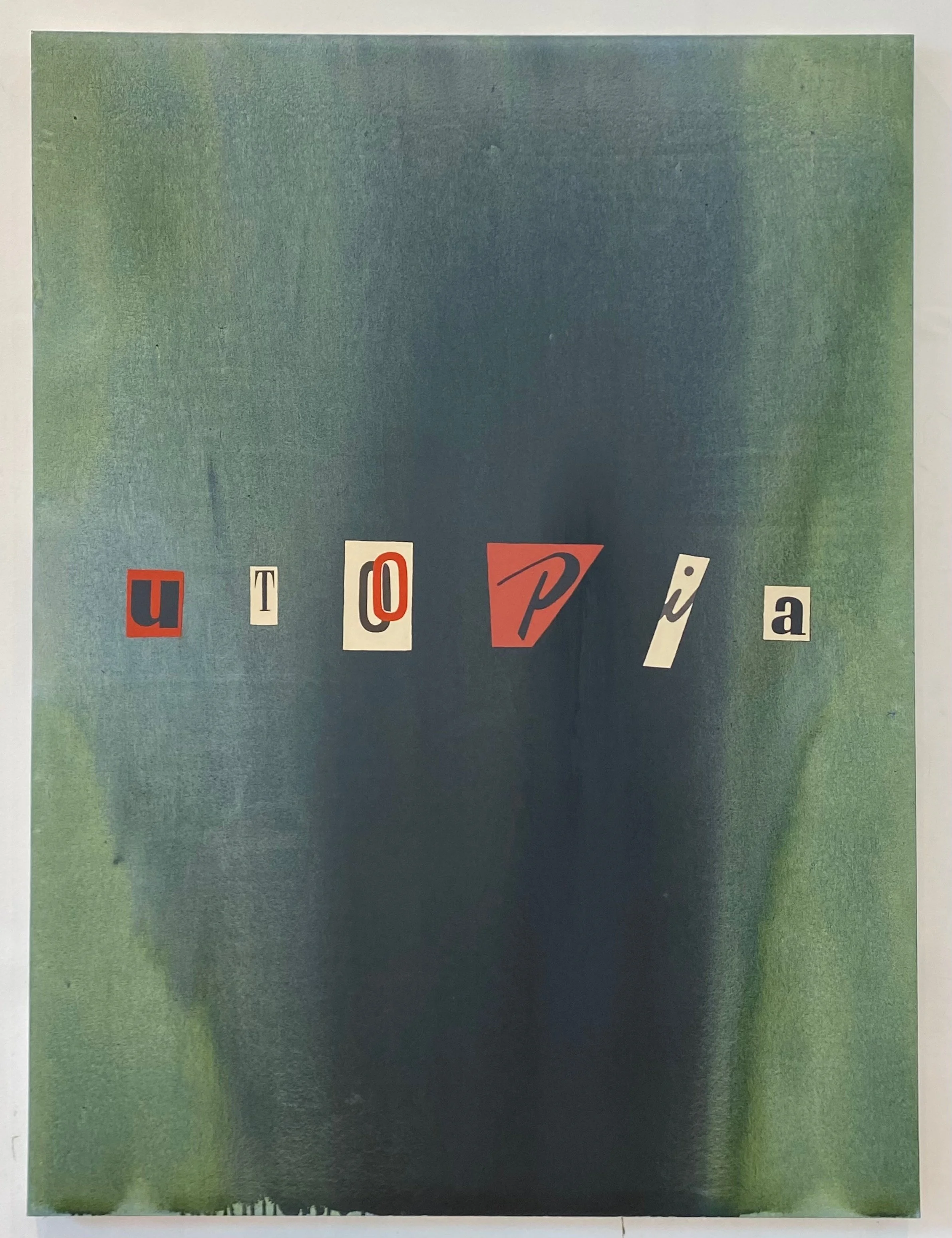
Simon Morley, ‘Found Utopia: The Picture Goer’s Annual, 1948’ (2025), acrylic on canvas, 120 x 80cm. From my new ‘Found Utopia’ Series. Collection of the artist.
Taking a deep historical perspective on the present reveals something fundamental: It turns out that all humanity’s hopes, from the time of the agrarian turn in the Neolithic and onwards into the post-agrarian epoch, have been premised on the stable climatic and biosphere conditions that characterise what is termed the Holocene.
These premises - assumptions of seasonality, meteorological limits, the assurance of renewal, possibilities of permanence and hence of settlement, faith in providence and hence of religion; inductive continuity and hence confidence in science – are no longer the unmovable foundations upon which human ‘civilization’ can be founded. But the the old anthropocentric yardstick of meaning and value that once were the axis of civilization has now, in the twenty-first century, demonstrably come into question. A whole new horizon of meaning and value is presently coming into view. From having been taken for granted as nothing but the backdrop to human affairs, the planet itself is now stepping forward as the primary protagonist.
All these factors, which constitute the radically new conditions of the present, have contributed to a profound epistemological crisis, which at a root is a crisis of truth. Open societies are experiencing a pervasive loss of faith in the once authoritative statements that served as key foundation stones. Above all, the legitimacy of science, the domain of ‘is’, the facts of life, has been undermined. There is no longer a consensus view of ‘reality’. This has had the positive effect of widening the horizon of possibilities; we can retrain the imagination in response to such a fast-changing world. But all too often this mental freedom devolves into delusional fantasy, into free-floating, more or less conscious projections of our minds.
Going forward, our hopes will have to be measured in significantly new ways. We need a paradigm shift in order to forge new models of hope. The task will be to imagine a shift in the focus of hope that prizes it apart from the global - that is, from its inherent and until now unacknowledged anthropocentrism - and instead forges a mythopoetic or religion of the planetary.
What will this shift towards a ‘non-anthropocentric hope’ or a ‘Gaia-centric’ hope entail? What will it look like? Whatever the case, unless new ideals of being and behaviour are envisioned and placed before our eyes as credible goals, we will never know what we and our society can become. We won’t know how to adopt a positive posture in relation to the future, and will lack the motivation to take the next step.
NOTES
[1] Yuval Noha Harari, Nexus (2025)
[2] Boaventura de Sousa Santos, ‘Uncertainty, between Fear and Hope’ THE CLR James Journal, 23:1–2, Fall 2017, 5–11, p.6. doi: 10.5840/clrjames2017121951